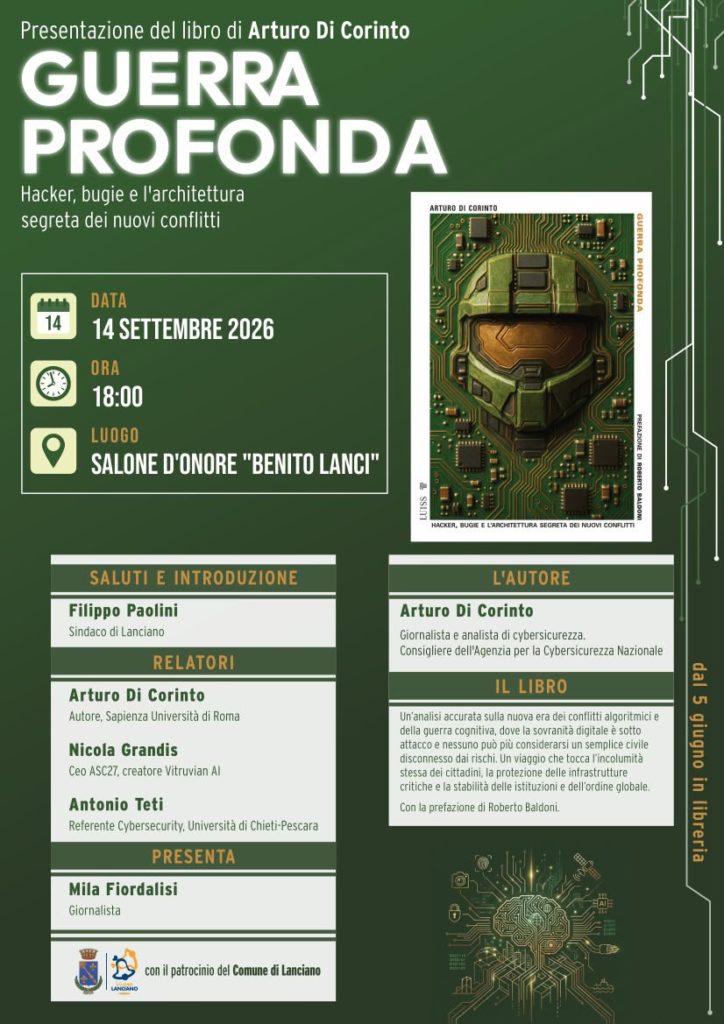
Il 14 settembre 2026, dalle ore 18:00, a Lanciano, si terrà la presentazione del libro di Arturo Di Corinto, “Guerra Profonda. Hacker, bugie e l’architettura segreta dei nuovi conflitti”.
Il libro Guerra Profonda, edito da Luiss University Press, sarà presentato e discusso dall’autore, Arturo Di Corinto con la partecipazione di relatori d’eccezione, tutti originari della cittadina teatina:
Arturo Di Corinto, giornalista
Nicola Grandis, Ceo ASC27, creatore dell’AI Vitruvian
È cambiata la guerra o è solo cambiato il modo di combatterla? Esiste una guerra giusta? Da Clausewitz a Putin: la guerra nel XXI secolo. Riflessioni sui conflitti nel mondo contemporaneo (Ledizioni, 2022), a cura di Matteo Bressan e Giorgio Cuzzelli, prova a rispondere a queste domande con un insieme di saggi a firma di studiosi ed esperti. Una parte consistente del libro riguarda gli elementi psicologici, tecnologici e giuridici della guerra che si combatte nel cyberspace.
Il quadro che ne emerge è tuttavia variegato. Nel saggio, la professoressa Fiammetta Borgia, ad esempio, per spiegare che cos’è la guerra ibrida sostiene che la guerra ibrida non esiste. E lo motiva dicendo che “Il concetto di guerra ibrida indica proprio quei conflitti o contesti di crisi in cui gli Stati e gli attori non statali sfruttano non solo i mezzi e metodi tradizionali, ma tutte le modalità di guerra simultaneamente, utilizzando armi convenzionali avanzate, tattiche irregolari, terrorismo e tecnologie dirompenti o criminalità per destabilizzare un ordine esistente”. Per conseguire un determinato obiettivo militare e politico, però, tutti i conflitti possono essere definiti ibridi. La guerra è ibrida per natura, perché viene sempre combattuta utilizzando tutti gli strumenti disponibili in quel momento storico e con il livello di integrazione e di coordinamento consentito dalla tecnologia del tempo.
Sembra dargli ragione Emanuele Rossi, esperto di geopolitica e relazioni internazionali quando fa l’elenco delle forme che può assumere la guerra, anche contemporaneamente: dal Command and Control Warfare all’Intelligence based warfare, dall’Electronic Warfare al Psychological Warfare, fino all’Hacker e Cyber Warfare e all’Economic Information Warfare.
Lui però ne sottolinea un aspetto specifico, quello delle Psychological Operations, perché dice: “I fattori psicologici sono altrettanto reali quanto i fucili, le navi, gli aerei e le armi nucleari”.
Nel saggio “Il potere della tastiera” invece, per spiegare la cyberwar e i suoi prodromi, Emanuele Gentili parla di hacktivisti, di Cyber Kill Chain e di APT, con una serie di riflessioni sugli hack di gruppi statuali cinesi, russi e iraniani fino al caso SolarWinds.
Il libro offre quindi una serie di riflessioni per dirci che nonostante i tanti nomi usati per evocarla, guerra infinita, guerra umanitaria, guerra asimmetrica, la guerra guerreggiata non è mai morta e che, forse, aveva ragione Eraclito nel VI secolo: il conflitto è alla base di tutte le cose. Anche della Pace.
La disinformazione organizzata e la cattiva informazione dei giornali a volte procedono insieme, e non è un caso che Rolf Wagenbreth, sottocapo della Stasi già negli anni ‘60 diceva: “L’uomo comune è sempre più inerme al cospetto di queste mostruose fabbriche di opinioni. Ed è qui che ci inseriamo noi come agenzia di intelligence.”
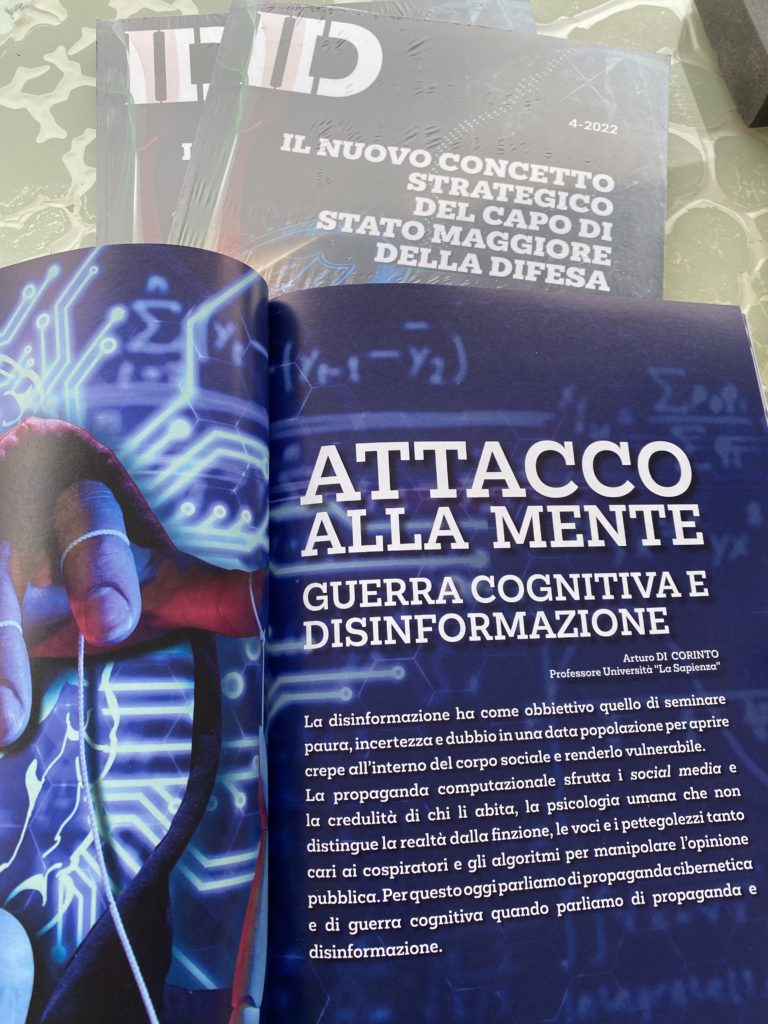
Felice e onorato di aver contribuito al nuovo numero di Informazioni della Difesa, il periodico bimestrale dello Stato Maggiore della Difesa (DIPICOM) diretto dal colonnello Antonio A. Russo e dal colonnello Roberto Lanni
XWe use cookies on our website to give you the most relevant experience by remembering your preferences and repeat visits. By clicking “Accept”, you consent to the use of ALL the cookies. Leggi tuttoRejectAccettoSettings
Privacy & Cookies Policy
Privacy Overview
This website uses cookies to improve your experience while you navigate through the website. Out of these cookies, the cookies that are categorized as necessary are stored on your browser as they are essential for the working of basic functionalities of the website. We also use third-party cookies that help us analyze and understand how you use this website. These cookies will be stored in your browser only with your consent. You also have the option to opt-out of these cookies. But opting out of some of these cookies may have an effect on your browsing experience.
Necessary cookies are absolutely essential for the website to function properly. These cookies ensure basic functionalities and security features of the website, anonymously.
Cookie
Durata
Descrizione
connect.sid
1 hour
This cookie is used for authentication and for secure log-in. It registers the log-in information.
viewed_cookie_policy
1 year
The cookie is set by the GDPR Cookie Consent plugin to store whether or not the user has consented to the use of cookies. It does not store any personal data.
Other uncategorized cookies are those that are being analyzed and have not been classified into a category as yet.
Cookie
Durata
Descrizione
nyt-a
1 year
This cookie is set by the provider New York Times. This cookie is used for saving the user preferences. It is used in context with video and audio content.
Advertisement cookies are used to provide visitors with relevant ads and marketing campaigns. These cookies track visitors across websites and collect information to provide customized ads.
Cookie
Durata
Descrizione
VISITOR_INFO1_LIVE
5 months 27 days
A cookie set by YouTube to measure bandwidth that determines whether the user gets the new or old player interface.
YSC
session
YSC cookie is set by Youtube and is used to track the views of embedded videos on Youtube pages.
yt-remote-connected-devices
never
YouTube sets this cookie to store the video preferences of the user using embedded YouTube video.
yt-remote-device-id
never
YouTube sets this cookie to store the video preferences of the user using embedded YouTube video.
yt.innertube::nextId
never
This cookie, set by YouTube, registers a unique ID to store data on what videos from YouTube the user has seen.
yt.innertube::requests
never
This cookie, set by YouTube, registers a unique ID to store data on what videos from YouTube the user has seen.
Analytical cookies are used to understand how visitors interact with the website. These cookies help provide information on metrics the number of visitors, bounce rate, traffic source, etc.
Cookie
Durata
Descrizione
_ga
2 years
The _ga cookie, installed by Google Analytics, calculates visitor, session and campaign data and also keeps track of site usage for the site's analytics report. The cookie stores information anonymously and assigns a randomly generated number to recognize unique visitors.
_ga_5VXPW099ZB
2 years
This cookie is installed by Google Analytics.
CONSENT
2 years
YouTube sets this cookie via embedded youtube-videos and registers anonymous statistical data.